Showing posts with label spasmodic dysphonia. Show all posts

Thursday, July 25, 2013

Effects of Spinal Alignment to Spasmodic Dysphonia

My last post ended with me hearing about this healing bed that works mainly by aligning the spine with the use of healing mineral stones.  Having heard that they give free trials, I decided to check it out.

When I arrived at the address stated in the flyer, I almost turned back - because the whole hall was jam-packed with people - mostly senior citizens.  Luckily, there is a separate room for first timers. But even that had a queue, so I had to wait outside for a couple of minutes.  I could hear a seminar/talk being conducted by a nurse regarding the benefits of the machine.

She was holding a doctor's sample skeleton, but it was just the spine.  It looked like this:

Doctor's plastic spine from Google
The nurse bent the "spine" towards the right.  As the spine was leaning, she pointed to the right side of the spine where the vertebrae are stacked together.  She then pointed to invisible nerves and blood vessels that are now pinched on the right side.  "If the spine alignment is wrong, there will be impingement of blood vessels.  And if the blood vessels are pinched, there would be less blood nutrients that can go to that particular organ ... "

By that time, I was imagining nutrients about to go to my vocal cords but are stopped because of vertebral impingement.  Or, I was thinking, perhaps if she's incorrect about the blood flow/blood vessels having a relation to vocal cord function, then nerve impingement could still be there.  So nerve communication could still be hindered.

Later on I found out that the Cervical Spine C3-C7 or the mid to lower neck areas are the ones that have nerves or blood vessels that are connected to the vocal cords.


Anyway to cut the story short, I tried it for about 12 to 15 consecutive days, liked it and bought the machine.  I also had scoliosis and upper back and neck pain so since the immediate effect was that of back pain, I decided to buy one and continue using it.  It was expensive though.  It costs about USD3,000 which is a lot of money here in our country if you convert it to Philippine peso.  But then, that's the way it is, medical relief comes with a price.  But it is worth it, for me.

The name of the machine is Nuga Best.  It's basically a bed with jade rollers.  You lie on it flat on your back and the roller goes up and down the spine massaging the back.
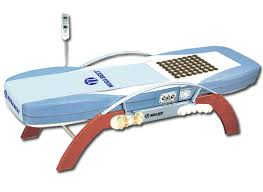

It wasn't hard for me to believe in the good effects of spinal alignment because I have been exposed to chiropractic in my teenage years.  And as for the jade stone rollers, because I know that jade stones have energy-giving properties.  I am half Chinese.  My grandmother made my sister wear a jade bracelet from China and somehow she noticed that she had been healthier when she was wearing it.  She contracted most of her illnesses after her bracelet broke and she didn't have it replaced.  She's back to wearing one.  It might be superstition for some, but I believe there is a scientific mineral composition explanation to it.

Well, I've been using the Nuga Best bed for 2 years now and it still helps my spine.  I'm not sure if it is this or the specialized voice therapy that has helped with my voice.  I did both in conjunction.  But perhaps the combined effect was synergistic.  I was re-training my voice with therapy and Nuga Best was helping solidify the new voice and heal the muscles and ligaments of the vocal cords.

Sunday, April 7, 2013

My Spasmodic Dysphonia and the Provincial Life

No voice = No income.

When I stopped earning, it was too expensive for me to live in Makati City (one of the Philippines' cities with the highest cost of living).  Therefore, I went back to my hometown, Tuguegarao.  


I'd have to admit, I wasn't too happy going back to the province -- the fields, rivers, caves, the cattle.  Yes, it does sound calm and serene, but I was in my mid- to late 20s!  I wanted to live in the city!  I loved my job!  I was getting paid really well and I've just recently been promoted!

Who dares to say that losing your voice is only a minor thing?  Don't we use our voices to order at restaurants, tell the cab driver where we're going, order water delivery, reply to the bank teller?  I know, they told me I can just nod and sign.  But it'll still be pretty awkward.  I tried, but then I get this weird look from the bank teller -- thinking that I'm either a snob or dumb.  I can't exactly blame them, anyhow.  My actions were kind of strange, not speaking.

So... when I arrived in my hometown, I shut myself in at home.  For 3 months.  Going out only for groceries and to go to church.


During that time, I was researching on other ways to get well.  I was looking up Dr. Morton Cooper, following his YouTube videos, learning about Connie Pike, Mike White's breathing techniques, and the rest of the SD treatments I've posted (link: http://voicecuresuk.blogspot.com/2012/09/spasmodic-dysphonia-therapies-reviews.html ).

One day, I saw a flyer about this miracle healing bed that supposedly cures a lot of ailments.  It says that the treatment is mainly about slowly aligning the spine (they use healing stones to do it which should add to the healing, I was told) and therefore releasing pinched nerves and other blockages so that the blood and nutrients would reach those specific organs that ails you -- so I was thinking my vocal cords now.  I also saw there's a free trial for it!

.... Running out of blogging time.  It's a Sunday and we have family lunch!  More about the bed on my next post ... 


Tuesday, March 26, 2013

Losing my Corporate Job Completely

Previously, I mentioned that my company granted me 6 months of sick leave, unpaid of course. I took that time to rest and focus on my voice healing. When the time came for me to go back to work, I still couldn't speak that well, and I feared that getting back into the swing of things would stress my vocal cords too much. My boss was truly generous for she offered me another 6 months of extension.


Fast forward to the end of that 2nd 6 months, I knew and felt in my voice that I cannot go back anymore. At least not when I'm not confident that my voice would stay even under pressure. And I don't want to shortchange my employer by going back, getting a good salary and being just half as effective (my work includes talking 70% of the time). So I had to officially resign.

It was a really depressing season for me. The uncertainty about my health and now the added uncertainty about my career. I was wondering how people with disabilities cope. I was thinking perhaps people who had their disabilities at a young age or since birth were much more likely to be able to adapt. It was especially hard when one has such high expectations of oneself. I used to be so goal-oriented, success-driven. I took failures very badly.


I guess since I have a Type A personality, and I've come face to face with something that makes me feel like it's not within my control -- I get upset!! That's how I felt.

Since then, I've learned to adjust. I'm still a Type A personality, I couldn't change, or... I don't know. Is it possible to change one's basic trait or predisposition? But all I know is that I'm still the same, I am still goal-oriented. I'm still driven to succeed. But there's a change in my thinking. At the way I approach things. I've learned the power of letting go - when needful. I still believe in working hard, but now I work hard outwardly but with internal peace. Striving, but with a happy attitude. And although I now have 65-75% of my voice back, I continue to adopt the "internal peace" demeanor. Somehow, it has helped me more than I thought it would.

Just the other day, I rode on a tricycle. The driver didn't hear me clearly and asked me to repeat myself. I felt frustration building up within me but I remembered to let it go. So I took a deep breath, relaxed my shoulders, and tried again. Thankfully, he understood what I said this time.

Looks like removing internal frustration, and just letting things be ("So what if he didn't understand me? I'll just repeat what I said. Simple as that.") somehow allowed my voice to get out from my throat.

Saturday, December 8, 2012

Voice Exercise - Extoning

I realized there may be others who are not familiar with Extoning. Or how to Extone. It's a term used by voice therapists which means to make a sound while breathing out.


It's like doing the one in the picture but with CLOSED MOUTH while letting the hum or sound go out.

The partner of Extoning would be Intoning. Which is making sound while breathing in. That comes later on in the voice exercise program.

Voice Teacher Alma Vajas would be a good instructor who can teach the basics of Extoning/Intoning and how to do them properly. I didn't learn from Alma, though. I learned from my online mentor who is her student. And the Smolover book also has a CD where you can hear the audio demonstration.

All the best - to all SD patients!

Friday, December 7, 2012

Smolover Voice Technique - for Spasmodic Dysphonia

I've decided to post here the 1st exercise I've done, which was the most effective method I've tried so far. It's from the Smolover Method.

I haven't been able to email back to most of the email queries I've received, sorry!! I'm getting married and moving to a different city exactly a month from now, and I didn't know there needs to be a lot of preparations to be done!

Better if I post my experiences and share here. Kindly just add me here or input your email address under Follow by Email so you'll receive updates :-)

There are some who said they do not wish other people to know that they have spasmodic dysphonia. So I won't include them here. But I also cannot promise to answer your queries if you want me to email you back one by one and privately.

Hi Diane Ryan - It's too bad that the Smolover book became out of stock! But no worries, you can do the exercise I'll be posting below. You can begin with this. It seems like a small thing, but it made a world of difference starting small!

Hi Syed - Alma Vajas already replied to my email! Well, not her but her recommended voice therapist. Her name is Terry. She does Skype sessions at USD90/session. If you're interested, just comment here and let me know.

Hi Cathy Lynn - I'm not sure now if I was able to reply to your 1st email! I think I did, but sometimes it turns out I only replied in my head.. The Chinese herbs I took helped my voice by lessening my acid reflux. I know I've read materials that say acid reflux has no effect on SD. But in my case, I think it has an effect. It's not the main cause, but since I already have existing SD, I could feel my acid triggering my loss of voice. But I think Pariet could give you the same anti-GERD effect.

Hi Peter - I hope the book helps your brother! Wait, which book are you referring to? At any rate, all of the books I bought were helpful: Connie Pike's, Dr. Cooper's and the Smolover book.

Hi Andrea - I bought the Student Version of Sing&See. It was helpful for doing Dr. Cooper's technique, especially at the start where I needed to find out my normal pitch and see if I'm talking within that pitch range. Although as I've progressed, I couldn't take the Sing&See with me anywhere. It'll be funny if I'm talking to a friend and I was attached to my laptop to see if my pitch is correct. ;D Although I did that with a good friend, explaining to her what I'm doing. :-) I'm using a real piano keyboard now with my continuing exercises because I can already detect which key I'm talking in/humming in.

Hi Lynn - I paid Dr. Cooper USD500 for the 30 minutes over-the-phone consultation. Hope you were finally able to get in touch with him!

Hi Ruth - I was thinking that in your case the book I'll be sending you would help only a bit. It discusses the theories and has some exercises, but they're mainly relaxation techniques. But they can only help so far. If ever you'll get a book, I suggest the Smolover book. I'll be transferring to Manila next month. If we have time, we can meet up in our place (if we do get to find a place to live in!!). I'll be bringing my piano-keyboards there, so I can show you how to do the exercises.

If I may have missed your email, my apologies. You can contact me or our other fellow SD patients here. It is good to share experiences and results.


So finally, here is the 1st exercise I did under the Smolover exercise. I did not edit my Pastor-mentor's email anymore:


Dear Misty,

The exercises in the book by Dr. Smolover start out very advanced. For the first one only extone. Sit relaxed in a quiet place. You need a piano keyboard, or I use a computer keyboard. Gently extone, think tiny. It is in the tiny that you will grow little by little. Start out as low as you can and go up to as high as you can. Take a couple minute break and then start up as high as you can and bring it down. Do this two or three times. When you reach as high as you can, try to go two notes higher. It will be hard, and it is work.

What you are doing is stretching the ligament by going up. You are also aligning it in order for it to make sound. This is the first exercise. Do this six days a week and take one day off.

Notes:
1. Don't worry about the quality of the sound as yet, just make pitch. Sound is made from your ligament so if there is sound your ligament is working.

2. In the beginning make sound any way you can. Little by little it will get better.

3. try to stay relaxed when making sound, though this may be hard.

4. The theory is like lifting weights. It takes time to get back in shape and it will take time for the exercises to work, but stay with it.

5. Do not worry about doing something wrong, just work your voice.

Hope this helps.

Wednesday, November 9, 2011

Chinese Herbs for Spasmodic Dysphonia

My cousin recommended a good Chinese doctor and I went to his clinic for a general checkup. He gave me some Chinese herbs to boil and told me to drink the concoction. I saw the assistants make the herbal preparation. They were different barks, leaves and other tree parts. Each ingredient had a different measurement.
It tasted like tea, very bitter tea. But it wasn't that bad. Or perhaps since I'm used to chinese medicine (my grandmother used to let me drink deer's horn extract and other chinese medications), this tea tasted alright. A closer look would show the barks and leaves:
After 3 days of drinking the concoction, my voice sounds louder and it's not as hard to control anymore! I don't know what these herbs are, but they sure do help :-)

Saturday, October 29, 2011

Putting the Voice Up in the Face

I would like to thank Valerie (my drill sergeant!) again for allowing me to post our email conversations in my blog.


Hi Misty,

It's okay if you feel it more in the mouth area than the nose. The main thing is to keep it away from the lower throat and bring it up and forward into the face. Dr. Cooper says, "the lower throat is no man's land." Keep at it. The whole rest of the week I "practiced on the numbers." Do it for as long as you need to. It's kind of hard doing it on your own and not having direction from Dr. Cooper or Connie right there with us. The more you do it, the easier it will be and then it'll click.

People spend the most time in the stage. Even after I left Dr. Cooper's office the hum and numbers was the exercise I did most often. After this stage, you move to humming with one syllable words like: cat, dog, rat, home, groan, ball, bat, boy, girl, etc.

Valerie

Sunday, May 8, 2011

Breathing Exercise Video (Squeeze & Breathe) for Spasmodic Dysphonia

This video was shared by voicematters.net head administrator and moderator Andrea Hardaway. Thanks, Andrea!


I do it whenever I feel my stomach area tighten. It’s a physical reminder for my stomach muscles to relax while breathing. SD patients tend to hold their breath (I’m so guilty of this!) while talking. It’s a bad habit common to us, based on books and posts I’ve read and my personal experience plus the experiences of other SD people I’ve communicated with.

Break!! I have to break that habit!!

Breathe.. Every 2 (two) words in my practice sentence, I breathe.. That’s just for now. Just to train myself to remember to breathe. And anyway, no sound comes out when I don’t breathe every two words..

Good luck to me! 

Sunday, April 24, 2011

What is Spasmodic Dysphonia? with Video and Voice Recording

Spasmodic Dysphonia is a voice disorder resulting from involuntary movements (or spasms) of the voice box muscles. These spasms interrupt normal voice (dysphonia) in "abrupt spurts" with a strained, strangled voice, with breathy, soundless voice, or with a mixture of both.
  • Spasmodic: spasms or involuntary movements
  • Dysphonia: abnormal voice
  • SD is a type of dystonia, a disorder of the central nervous system that causes involuntary movement of the vocal folds during voice production.
  • SD is not a psychiatric or psychological disease.
  • Swallowing and breathing, the other important functions of the voice box, are almost never affected.

Three (3) Types of Spasmodic Dysphonia

Type
What Happens
How the Voice Sounds
Adductor SD (80% to 95% of cases)
Vocal folds come together (close) tightly at the wrong time during speech, making it difficult to produce voice
Strained, strangled breaks while speaking
Abductor SDM
Vocal folds move apart (open) at the wrong time during speech, causing air leaks
Breathy or soundless breaks while speaking
Mixed SD
Combination of abductor and adductor SD
Sometimes strained, strangled breaks; sometimes breathy or soundless breaks

Unknown Cause–but Treatment Can Improve Voice Problem.

For spasmodic dysphonia, like all dystonias: 
  • the cause is unknown
  • there is no specific test for diagnosis
  • there is no known cure–but treatment can and does improve symptoms
What I have been diagnosed with is ABductor Spasmodic Dysphonia (ABSd), the rarer kind, wherein I sound breathy and whispery, NOT hoarse. It sounds more like when you’re shy to talk in front of a huge crowd.

I found a video by Dr. Robert Bastian which helped me. It describes SD, it’s different types, shows actual video of vocal cords while speaking plus it  has voice demonstrations of the different kinds of SD.

Dr. Bastian used the script Man’s First Boat – “Long ago, man found that it was easier to travel on water than on land.”


I have also attached a record of my voice clip reading Man’s First Boat. This clip was recorded 01/31/2011. I'll post my latest voice recording soon.

Wednesday, April 20, 2011

How I Lost my Voice

What I Lost

“It started with a cough almost 2 years ago. I remember the date, because it was my 27th birthday..”

Pause. First, I’d like to make clear my two (2) reasons for writing this blog.
  1. I am writing this for myself – to record my thoughts, treatments, what worked, what didn’t. Documentation is key.
  2. I doubt if someone else will find this site but if you did and you have a vocal disorder of ANY kind, I hope you will find this blog both helpful and therapeutic.
Just Prior to the Onset of the Problem

Going back to my story, two years ago I celebrated my birthday in Baguio City, one of the coldest places in our country, the Philippines. I decided that I deserved a week-long break from 6 months of past-paced, stress-filled work. I was with an executive search firm and we just experienced change in management, lots of resignations plus new clients.

The Problem Begins

During August 2009 in that week-long vacation, I came down with the flu. It was bad, I was miserable the whole duration of the break. If it were not for my family and boyfriend being there, it would have been a horrendous experience. Well, looking back, I think I can say it is. Because it was the beginning of a little known disability – voice loss.

My 27th Bday - with my family and bf.
That's me standing beside my dad.
I went back to work feeling better. But my voice was hoarse, which is normal for someone with colds and cough. Then 2 weeks went by and the colds and cough remained. By that time it was already September. I went to the doctor who prescribed antibiotics for the cough. In a couple of days, the cough was gone. But my voice still did not return to normal. I thought it will eventually go back by itself. But it felt weird when I was speaking. It didn’t sound hoarse anymore or nasal (like during colds). It was more whispery. I still had voice, though. I just needed to force it out a bit more.

The Problem Didn’t Go Away


Life went on – Work. Stress. Church activities. Family. Daily workout. Friends.

By October, my friend and I decided to put up a small water station business. And so we went to work. I had to focus on it after my 9am to 6pm hours. During this time I was staying at the office until 8pm, sometimes 9pm.

Finding out What’s Wrong

By November, my voice was very weak and whispery. I went to the top hospitals and recommended specialists (ENT and gastroenterologists):

  1. Dr. Emmanuel Ibay of Makati Medical Center – diagnosed me with sulcus vocalis after doing Fiber optic Laryngoscopy, a procedure which involved putting a tube down my nose to see how the vocal cords function. This is a very good procedure to do to check how the vocal cords work. They ask you to produce sounds while the tube is inside.
  2. Dr. Melchor Chan of University of Santo Tomas (UST) Hospital – who performed Endoscopy, which is swallowing a tube the size of an I.V. or dextrose tube. At the end it has a camera. The doc will be able to see if your esophageal sphincter, the opening of the stomach, opens and closes correctly. To check the possibility of acid reflux affecting the voice box. He said my sphincter was working well, for someone who had childhood achalasia.
  3. Dr. Adonis Jurado of Children’s Medical Hospital/ Philippine Heart Center – He endorsed me to have Esophagram or Barium Test, which is swallowing a very thick paste-like substance. Then the radiologist will make a series of xrays on the substance’s movement. Test did not show any reflux of the substance.
  4. Dra. Clarissa Fortuna of Medical City – performed Laryngoscopy again and said I have no vocal cord problems. (Later on, I discovered that some vocal disorders can sound normal at times, and dysfunctional at other times. At the time I was having my laryngoscopy with Dra. Fortuna, my vocal cords felt normal.)
  5. Dra. Feliciano of St. Luke’s Hospital – diagnosed me with Spasmodic Dysphonia ABductor Type by listening to my voice and looking at my laryngoscopy DVD.
  6. Dr. William Lim of Holy Infant – the doctor of Kris Aquino (or so I was told. Kris Aquino is a well-known TV host in the country). He diagnosed me with AB/SD (ABductor Spasmodic Dysphonia after performing another Laryngoscopy.
  7. Speech Pathologist Connie Pike based in Florida, USA – reviewed my case and said she believes I have AB/SD.
  8. A Neurologist (forgot her name) in Saint Louis University Hospital in Baguio City – endorsed me to have Magnetic Resonance Imaging MRI in Cardinal Santos Medical. She wanted to rule out any brain damage. Results turned out negative, but showed that I had acid reflux in the form of gas.
There were other doctors I had consulted but the above were the more prominent and significant. It was Dra. Feliciano who was the 1st to say it was Spasmodic Dysphonia. And she did it just by listening to me talk. Afterwards, she checked my video to confirm. But her initial diagnosis remained. She steered me in the right course, and I will always be grateful. Incidentally, I forgot her first name!!

I went through a lot to find out what was wrong with me. With the number of times I had tubes being inserted in my nose and mouth, I wish I could say that I have gotten used to them. But every time, it is as uncomfortable as the first one.

I already got weary writing these down. I didn't realize how many I've gone to. Hospitals and doctors. I haven’t even mentioned any of the prescription medicines I’ve been given! This is why I did not write about my vocal disorder in the past. But a respected mentor told me simply “blog about it.” WHAT??! But to be fair, he has no idea about how much this issue is a struggle for me. And how I HATE to write about frustrations. (I record triumphs, not hardships). But then again, I should thank him for suggesting it. I have to admit it IS therapeutic.